
Top Retirement Questions from Arizona Retirees & Pre-retirees
Over the last decade, I’ve worked with hundreds of individuals across the valley that were approaching or in retirement. I recently started keeping track of what they’re asking, so I can share it with others who are just as curious. Here are the questions that most frequently come up.
What tax advantages are there?
Before getting into rankings and cities, it’s worth laying out exactly what Arizona does and doesn’t tax, since this is usually the first thing that draws retirees to the state.
| Tax Category | How Arizona treats it |
|---|---|
| Social Security benefits | Not taxed |
| Military retirement pay | Fully exempt from state income tax |
| IRA, 401(k), and private pension | Taxed at Arizona's flat rate |
| State Income tax rate | Flat 2.5%, one of the lowest in the country |
| Estate or inheritance tax | Not taxed |
| Property Tax | Averages 0.56%, well below 1.02% national average |
| Sales Tax | Combined state and local average of 8.52%, among the higher rates nationally |
If your estate is large, estate and inheritance taxes are worth a closer look. A well-known NBER study took 18 years of federal estate tax returns between 1965-1998 and found that high state estate, inheritance and sales taxes modestly reduced the number of wealthy estates filed in a state, which we’ve seen with plenty of affluent older clients. Taxes may not be the deciding factor on your retirement destination, but they certainly are an important consideration for many families and HNW individuals.
Can I afford this city, or should I look elsewhere in the Valley?
That depends on how you're funding the purchase and what study you’re reading. WalletHub’s 2026 retirement ranking puts Arizona 23rd overall in affordability. A separate ranking from Common Sense Institute Arizona ranked Arizona 45th in affordability earlier this year, which garnered lots of attention because of how much more affordable the state used to be. Our states cost of living index was last registered at 110.7, so we’re 10.7% more expensive than the national average. This has been driven mostly by housing costs, where in the last decade, the median listing price has gone up 58.4% despite the pullback we’ve seen over the last several years as you can see in the graph below.
Retirees who bring substantial home equity from a previous sale tend to make it work comfortably. The ones who run into trouble are usually financing the purchase in todays rate environment and underestimating what the HOA and lifestyle spending add on top of the mortgage.
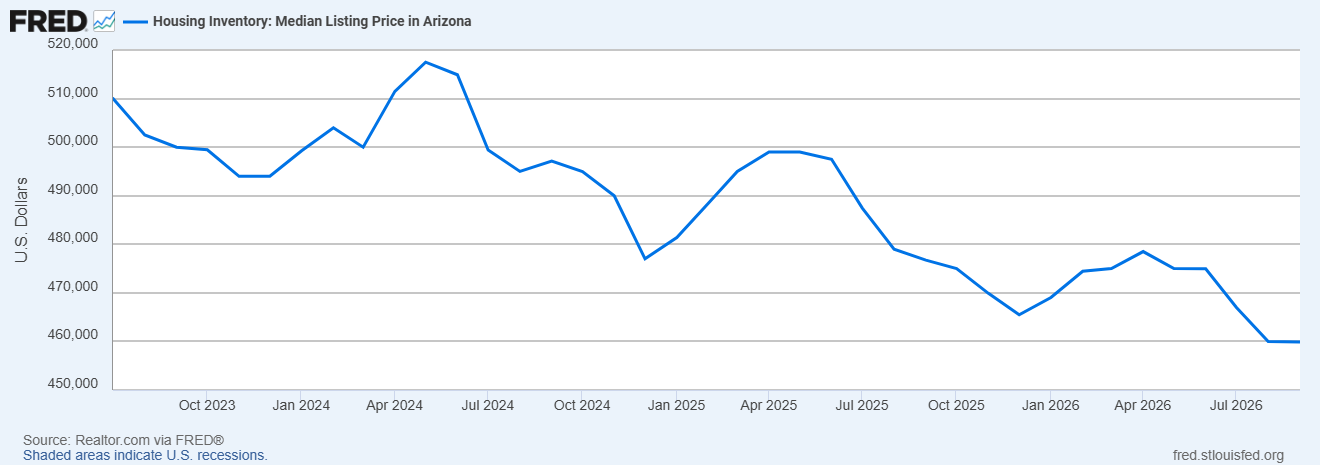
Arizona’s median listing price has made three peaks and three valleys since 2023, and each one is lower than the last. It has fallen from about $517,000 in mid-2024 to about $458,000 now, roughly 11%.
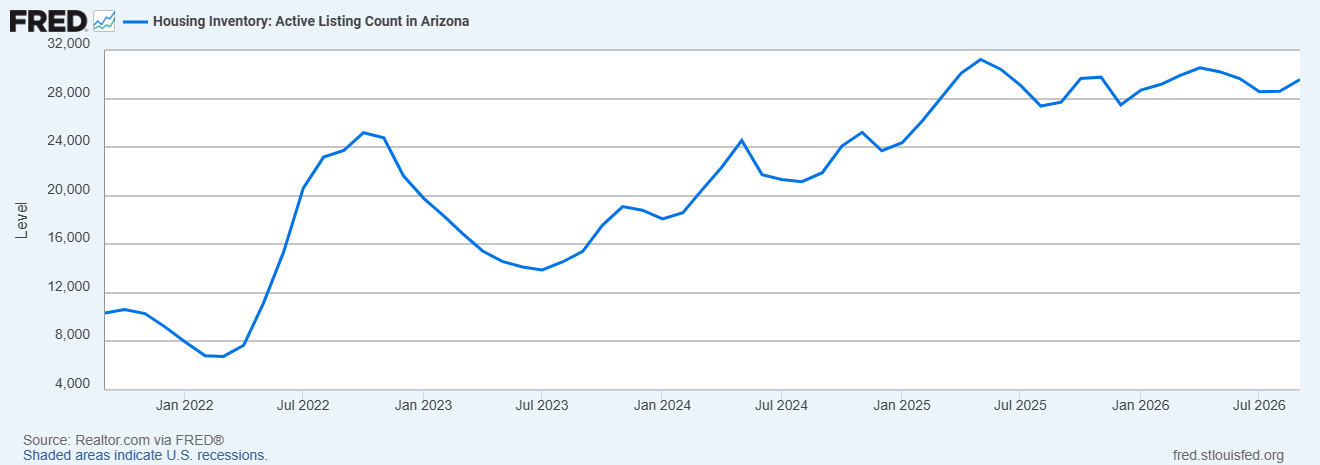
Active home listings in Arizona have roughly doubled since mid-2023 and now sit around 30,000.
What happens to my health insurance before Medicare kicks in?
Most people underestimate this one. If you retire before 65, you need to cover the gap yourself. The most common route is a plan from the ACA marketplace, where your retirement income sets your subsidy. Which accounts you draw from changes that income, so the order of your withdrawals can lower your premiums more than you’d expect.
Outside the annual open enrollment period, you can still sign up if a qualifying life even open a ‘special’ open enrollment period. Common triggers include:
Marriage or divorce
Birth or adoption of a child
A permanent move
Loss of other health coverage
Changes in household income
Once you're on Medicare, the next decision is Medicare Advantage versus original Medicare with a Medigap supplement. Phoenix and Scottsdale have strong networks, including Mayo Clinic, but Medicare Advantage plans are network-dependent. If you travel often or split time between states, a Medigap policy typically gives you more flexibility. Check that your specific doctors accept your plan before you commit!
Client example: In April 2025, one of my clients was laid off from his company. Losing his employer coverage qualified him for a special enrollment due to the change and we found him a plan that was far more affordable than electing COBRA. About 2 months later, he was referred to a new doctor due to some health concerns, but they weren’t in his plan network. He wasn’t sure that it was possible since he recently started his new plan, but because of a recent move, he qualified and was able to make the change. Although uncommon, special enrollment periods can come up more than once, so a plan chosen under pressure may be changeable later.
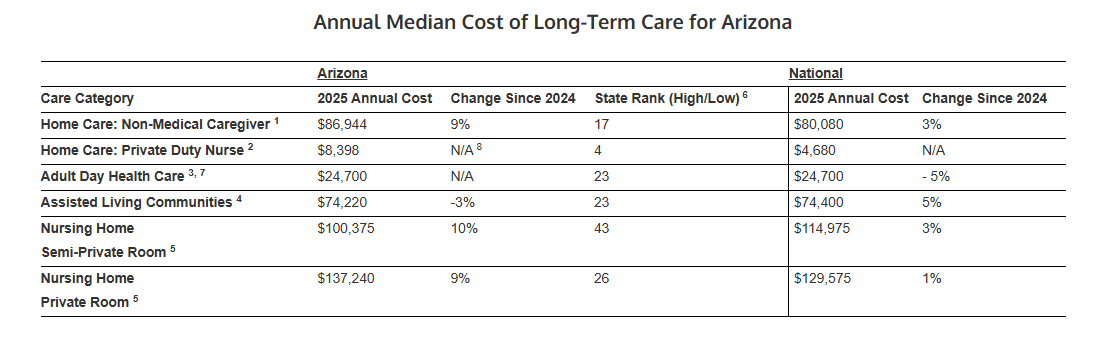
What about long-term care costs in Arizona?
Medicare does not pay for long-term care. It covers a limited stay in a skilled nursing facility after a qualifying hospital stay, up to 100 days, and nothing for ongoing help with daily living. Arizonans who need that kind of care pay for it themselves, through insurance, or through Medicaid once they’ve spent down their assets.
Plan for this before you need it. A common option among the clients we’ve worked with is to set aside part of your portfolio for care, but others are to consider LTC insurance while you’re healthy enough to qualify, or relying on Medicaid as a last resort. Each of these options has costs and considerations, and the right choice depends on your assets, your health and your family. If you currently live here, this would be a good time to evaluate whether your current residence will work as you get older, or whether a move to a community makes more sense.
How much do I actually need to retire?
There's no single number that applies to everyone, but by using GOBankingRates’ method, Arizona retirees need about $1.14 million at minimum, based on $66,838 in annual living costs less roughly $22,400 in Social Security. That figure is a state average. In pricier cities like Scottsdale, expect to need more, and in Paradise Valley the number says little because housing costs sit far above the average.
| Measure | Figure |
|---|---|
| Cost of Living Index | 110.7 |
| Annual Cost of Living | $68,005 |
| Expenditures after Social Security | $45,568 |
| Savings needed | $1,139,200 |
Which Arizona city is the best fit for retirement?
It depends on what you're optimizing for. Here's how the main options break down.
Phoenix: The best airport and healthcare access in the state, with a median home value around $406,000. Of course, there’s always a trade-off. Here it’s the most extreme summer heat of any major Arizona city.
Scottsdale: The most upscale option, with Mayo Clinic access and a resort feel, but the most expensive: median home values run $851,000 depending on the area, and North Scottsdale HOA and lock-and-leave fees commonly add $250 to $450 a month on top.
Paradise Valley: The valley’s most exclusive address, a small town of large lots and custom estates between Phoenix and Scottsdale, with a median home value around $3.5 million.
Gilbert: A family oriented East Valley suburb with mostly newer homes and plenty of parks, popular with retirees, with a median home value around $567,000. It costs noticeably more than Mesa, though well below Scottsdale.
Mesa: A practical middle ground in the East Valley, with a median home value in the mid-$400,000s and a large concentration of 55+ communities.
Tucson: The most affordable major metro in the state, with a median home value around $322,000, University of Arizona culture, and Banner University Medical Center for specialist care, at a lower elevation than Prescott or Flagstaff.
Prescott: The most popular non-Phoenix retirement market, sitting at roughly 5,400 feet, which trades some of Phoenix’s healthcare depth for real seasonal relief from the heat. Median home values run around $597,000.
Flagstaff: The highest elevation of the main retirement markets, near 7,000 feet, with genuine winters and a median home value around $656,000. This is the choice for retirees who want Arizona's tax advantages without desert summers.
Sun City and the West Valley: The most affordable path into the Phoenix metro, with median home values in Sun City running $295,000 to $480,000. Surprise, Goodyear, and Peoria are the fastest-growing retirement area in the Valley.
What if I only live here part-time?
Plenty of retirees spend the winter months in Arizona and the summer somewhere cooler. Taxes, weather and health care all play a part. The tax result depends on which state the IRS and state consider your home, and that is a legal question of domicile.
Domicile is usually settled by facts you can document. These include where you hold your driver’s license, where you’re registered to vote, where you file your tax return, where you doctors are and which home you treat as your primary residence. Keep them consistent. A retiree who moves to Arizona on paper but still votes, banks and sees doctors in the old state is asking for an audit.
What are the hidden costs of living in Arizona?
The tax savings get most of the attention. The costs that surprise new residents tend to be smaller, but you should still be aware of them.
Cooling: Air conditioners in this climate work overtime for months at a stretch, so budget for a replacement during retirement instead of treating it as a one-time surprise.
HOA dues: Almost a third of all homes in the state have an HOA, and we are among the nation’s highest in terms of monthly costs.
Sales tax: As mentioned before, Arizona’s combined state and local rate averages around 8.52%, which is one of the higher rates in the country. Of course, the state makes up for some other tax savings through this higher sales tax.
Other costs: Insurance, pool service if the house has one, pest control and the rising cost for water. None of these are large alone, but they add up.
Where to go from here
Whether you’re thinking about moving to Arizona or you’ve lived here for years, the same few decisions drive your retirement: where you live, how your income is taxed, how you’re covered for health care, and how long your savings need to last. The information above is a starting point, and your own answer depends on your city, your accounts and your timeline.
If you’d like a second set of eyes, I’m happy to run through your specific situation and set of numbers with you. For newcomers, that means comparing cities and the tax picture. For current residents, it’ll mean checking your withdrawal plan, your coverage before or after 65, or whether a move within the valley changes your plan.
Sources: Home values from Zillow Home Value Index and Redfin, current as of mid-to-late 2026.
Do the Rich Flee from High State Taxes? Evidence from Federal Estate Tax Returns | NBER
Affordability and retiree rankings from WalletHub's 2026 "Best and Worst States to Retire," Choice Mutual's 2026 retirement ranking, and America Dashboard's Arizona state ranking. Figures are illustrative and change regularly; confirm current values before making a decision.
Realtor.com, Housing Inventory: Median Listing Price in Arizona [MEDLISPRIAZ], retrieved from FRED, Federal Reserve Bank of St. Louis; https://fred.stlouisfed.org/series/MEDLISPRIAZ, October 7, 2026.
Realtor.com, Housing Inventory: Active Listing Count in Arizona [ACTLISCOUAZ], retrieved from FRED, Federal Reserve Bank of St. Louis; https://fred.stlouisfed.org/series/ACTLISCOUAZ, October 7, 2026.
Savings You Need To Retire in Every State | GOBankingRates
Housing Affordability in Arizona 2026 – Common Sense Institute
Best States to Live In (2026)
Find out if you can get health coverage now
https://www.carescout.com/cost-of-care
This article is for educational purposes only and does not constitute personalized investment, tax, or legal advice. Consult a qualified fiduciary advisor and a licensed insurance professional about your specific situation. Macallen Capital is a fee-only fiduciary RIA. Macallen Capital is a fee-only fiduciary RIA serving Phoenix-area retirees and clients nationwide.