
Medicare 101 for People Turning 65

Medicare looks simple from a distance. You turn 65, you're covered, done. Up close, it's four separate parts, a handful of enrollment deadlines with real penalties attached, and a premium that isn't the same for everyone. Most of the confusion isn't about whether to enroll. It's about not knowing there were this many decisions hiding inside what sounded like one.
The four parts, briefly
Part A covers hospital stays, skilled nursing care, and hospice. Most people don't pay a premium for it, since it's funded by the Medicare taxes withheld from decades of paychecks.
Part B covers doctor visits, outpatient care, and preventive services. The monthly premium is $202.90 per person in 2026, and this is the piece most people mean when they ask what Medicare actually costs.
Part C, also called Medicare Advantage, is a bundled alternative offered through private insurers that combines Parts A and B, and usually Part D, into one plan, often with extra benefits like dental or vision.
Part D covers prescription drugs, sold through private insurers as a standalone plan or bundled into a Part C plan.
When you actually need to enroll
Your initial enrollment window is seven months long: it starts three months before the month you turn 65, includes your birthday month, and extends three months after. Miss that window without qualifying coverage elsewhere, and Part B carries a late enrollment penalty that isn't temporary. It's added to your premium permanently, for as long as you have Medicare.
If you're still working past 65 and covered by a qualifying employer plan, you can generally delay enrollment without a penalty, but that exception has real conditions. It matters whether the employer has 20 or more employees, and whether the coverage actually counts as qualifying. Confirm both directly rather than assuming. Getting it wrong is exactly how people end up penalized years later for a decision that felt obviously fine at the time.
What Medicare actually costs, and why it isn't the same for everyone
Part B has a standard monthly premium of $202.90 in 2026, but higher earners pay more through a surcharge called IRMAA (Income-Related Monthly Adjustment Amount). That's where Medicare stops being a flat cost and starts requiring real planning.
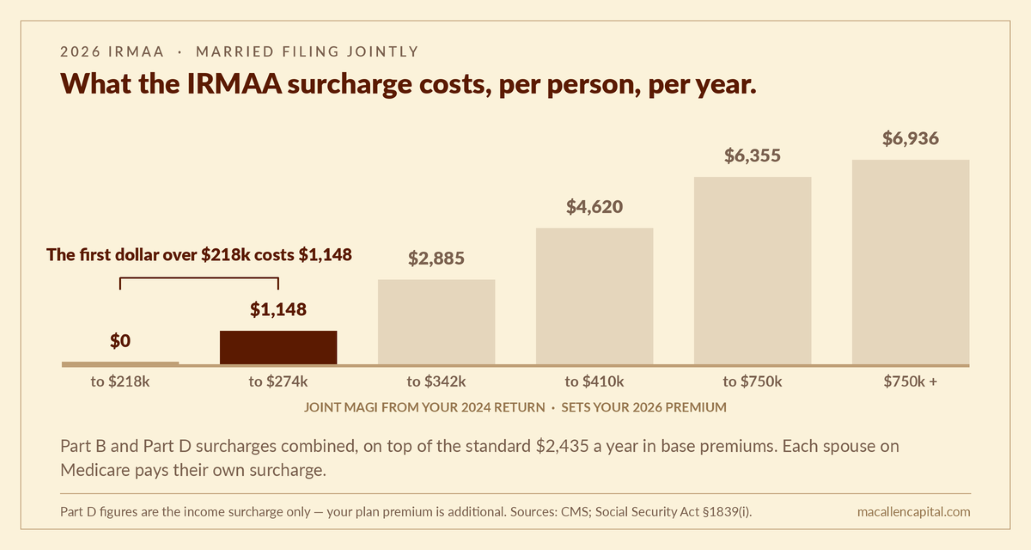
If your income two years ago was above certain thresholds ($109,000 for a single filer, $218,000 for a married couple filing jointly in 2026), IRMAA adds a surcharge on top of the standard Part B premium and a separate surcharge on top of Part D. Both use the same income brackets, so a high-income year raises drug coverage costs alongside the Part B premium. The brackets step up from there. At the top tier, the total Part B premium is more than triple the standard amount.
Two features of IRMAA catch people off guard every year. First, it looks back two full tax years. What determines your premium this year is your tax return from two years ago, not your current income. Second, it's a cliff. Cross a threshold by even a small amount and the full surcharge for that tier applies, with no proration.
Why this connects directly to the years before 65
If you've been following the withdrawal order or Roth conversion conversation, this is exactly where it lands. A Roth conversion, a large capital gain, or a single unusually high-income year can set your Medicare premium two years later, often after the decision that caused it is long finished and forgotten.
The same lookback mechanic applies to ACA marketplace subsidies for people retiring before 65. The mechanism differs: with IRMAA a surcharge is added to Medicare, while with ACA subsidies the subsidy is reduced. But the result is the same. Income decisions made years before 65 shape healthcare costs that show up two years down the road, whether that's a smaller ACA subsidy before 65 or a larger IRMAA surcharge after it.
What to actually do about it
Know your enrollment window and don't let it pass by accident, especially if you're not confident your employer coverage still qualifies as a delay exception.
The income on your tax return two years before you turn 65, not your income at 65, determines your first IRMAA bracket. If you're planning a large Roth conversion or a high-income year in the years leading up to Medicare, map out when that decision will show up in your premium. Both Parts B and D carry surcharges, so crossing a bracket costs more than one line item.
If a qualifying life-changing event pushes your current income well below what the SSA is using to calculate your premium, an appeal is available. Qualifying events include retirement, a spouse's passing, divorce, and a significant reduction in work hours. The form is SSA-44. It asks for documentation showing your income has dropped materially since the lookback year. If approved, the SSA uses the more recent income figure instead. The appeal is underused, mostly because people don't know it exists. A one-time income spike (a home sale, an inheritance) generally doesn't qualify. The mechanism is designed for events that changed your ongoing income level, not years when income happened to be higher than usual.
One planning detail worth adding to the pre-65 window: for tax years 2025 through 2028, filers age 65 and older get an additional federal deduction of up to $6,000 (single) or $12,000 (married, both spouses 65 or older), on top of the existing standard deduction. It phases out above $75,000 for single filers and $150,000 for married couples filing jointly. Roth conversions or other income events that push you over those thresholds reduce or eliminate it. Coordinating conversion size and timing with this phaseout adds one more factor to the pre-Medicare income picture, and one more reason to act before income rises.
A note for Arizona retirees specifically
IRMAA is a federal calculation based on federal MAGI, so state tax treatment doesn't change which bracket you land in. But Arizona's tax structure affects how much it costs to do something about it in the years before Medicare.
Arizona taxes most retirement income, including Roth conversions, at a flat 2.5%, one of the lowest rates in the country. The state also doesn't tax Social Security at all. Together, those two facts make the low-income years before Medicare an unusually inexpensive window to convert traditional IRA dollars to Roth at the state level, on top of whatever federal bracket management already makes sense. The federal IRMAA timing question is the same no matter where you live. The state cost of acting on it is lower in Arizona than in most places.
2026 Medicare Parts A & B Premiums and Deductibles | CMS
Get started with Medicare | Medicare
SSA-44
Individual Income Tax Information | Arizona Department of Revenue
This article is for educational purposes only and does not constitute personalized investment, tax, or legal advice. Consult a qualified fiduciary advisor and a licensed insurance professional about your specific situation. Macallen Capital is a fee-only fiduciary RIA.