
Required Minimum Distributions: What They Are and When They Start

A client called me the week she turned 73, mildly panicked. She’s known what this milestone has meant for years, and alas, it was finally time to give into the IRS’s demands.
It was true, and it wasn't as dramatic as it sounded, but it's a moment that catches a lot of people off guard. After decades of being told to save into a traditional IRA or 401(k), the government eventually requires you to start taking it back out, whether you need the income or not.
What an RMD is
A required minimum distribution is the smallest amount you're allowed to withdraw from a traditional IRA or 401(k) each year once you reach a certain age. The account grew tax-deferred for decades, and RMDs are how the IRS finally collects tax on that money.
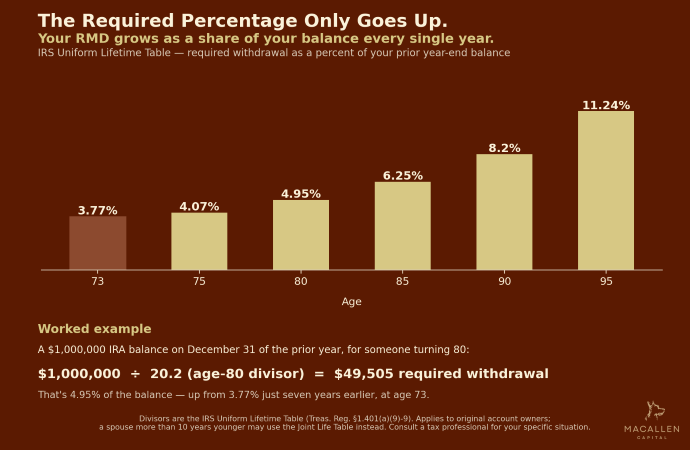
The amount isn't arbitrary. It's calculated by dividing your account balance on December 31 of the prior year by a life expectancy factor from the IRS's Uniform Lifetime Table. As you get older, that factor shrinks, which means the required percentage grows each year. As a simple example: a $500,000 IRA balance divided by a life expectancy factor of 24.6 produces an RMD of roughly $20,325 for that year.
When RMDs start
This is the part that trips people up, because the starting age isn't the same for everyone anymore. SECURE 2.0 split it by birth year.
If you were born between 1951 and 1959, your RMD age is 73. If you were born in 1960 or later, your RMD age is 75. Two extra years of tax-deferred growth is a meaningful difference for anyone in the younger group and it's important to know which bucket you fall into rather than assuming.
One exception that catches working clients off guard: if you're still employed and participating in your current employer's 401(k), you may be able to delay RMDs from that plan until the year you actually retire as long as you don't own more than 5% of the business. This doesn't apply to IRAs or old 401(k)s from former employers, but it's a meaningful planning lever for clients still working in their early 70s.
Your very first RMD comes with a quirk: you're allowed to delay it until April 1 of the year after you reach your RMD age, instead of taking it by December 31st like every year after. That sounds like a benefit, but you should certainly do your due diligence.
The two-RMD trap
If you delay your first RMD to that April 1 deadline, you still owe your second RMD by December 31 of that same calendar year. That means two full distributions land on the same tax return, which can push you into a higher bracket than if you'd simply taken the first one on time the year before.
This is a case where the technically-allowed option isn't automatically the smart one and without knowing better you can easily make a mistake. Whether delaying makes sense depends on what your income looks like in each of those two years, not just on the fact that the IRS permits it.
What happens if you miss one
Until recently, the penalty for missing your RMD was a severe 50% of the amount you should have withdrawn. SECURE 2.0 brought that down to 25%, and down further to 10% if you correct the mistake within two years. That's a real improvement, but it's still a penalty worth avoiding entirely rather than treating as a minor inconvenience.
A few rules that catch people off guard
Multiple IRAs get combined; 401(k)s don't. If you have several traditional IRAs, you calculate the RMD for each one separately but can withdraw the total from any single account or combination of them. 401(k) plans don't work that way as each one requires its own distribution. 403(b) accounts follow the same aggregation rule as IRAs: calculate each separately, but you can satisfy the total from any one of them.
Roth accounts are different now. Roth IRAs have never required distributions from the original owner during their lifetime. Roth 401(k)s and Roth 403(b)s no longer do either, which removed a workaround people used to need which was rolling a Roth 401(k) into a Roth IRA just to avoid an RMD that no longer applies anyway.
Inherited accounts follow entirely different rules. If you've inherited an IRA or retirement account, the distribution rules are separate and more complex than what's described here. That topic deserves its own conversation, so don't apply what you've read above to an inherited account without checking with your advisor first.
You can give an RMD directly to charity. A Qualified Charitable Distribution (QCD) lets you send money straight from your IRA to a qualified charity, and that amount doesn't count as taxable income. For 2026, the annual QCD limit is $111,000 per person. Importantly, QCDs are available starting at age 70½, which means charitably inclined clients can start using this tool two or three years before distributions are even required. QCDs apply to IRAs only; you can't make one directly from a 401(k) or other employer plan. This is one of the more underused tools available to retirees who are charitably inclined and don't need the income to live on.
Why this deserves planning before age 73
The biggest mistakes we see are when clients don’t think about their RMDs until they start. A large traditional IRA that's grown untouched for years produces a large RMD that will possibly push you into a higher bracket, trigger IRMAA surcharges that increase what you pay for Medicare, or make more of your Social Security taxable, all at once.
The years before your RMD age are exactly when tax strategies and coordination with other partners should happen.
This article is for educational purposes only and does not constitute personalized investment, tax, or legal advice. Consult a qualified fiduciary advisor and a tax professional about your specific situation. Macallen Capital is a fee-only fiduciary RIA.