

A client asked me a fair question recently. He wanted to know what would happen to his retirement if the market did in his first year of retirement what it did in 2008.
Most people ask that question the week the market actually drops. To him, the wounds of 2008 are still fresh, so while it’s still just a number on a page instead of a real threat to his monthly income he wanted an answer.
A retirement plan that’s never been stress-tested isn’t really a plan. It’s an assumption that things will go the way they usually do, and retirement is exactly the wrong time to find out they didn’t.
Why a crash in retirement is different from a crash while working
A market downturn while you’re still working and saving is uncomfortable, but time is on your side. You keep contributing, prices are lower, and the recovery eventually erases the damage on the screen.
A market downturn early in retirement works differently. You’re not adding money, you’re pulling it out. Selling investments after they’ve dropped to fund your monthly spending locks in losses that a portfolio still growing wouldn’t have to take. This is sequence of returns risk, and it’s one of the least understood threats to an otherwise concrete retirement plan.
What sequence of returns risk looks like
Two retirees can have the exact same average return over 20 years and end up in completely different places, depending on the order those returns arrived in. A retiree who sees a strong market in the first five years of retirement, even if the next fifteen are mediocre, tends to be fine. A retiree who sees a weak market in the first five years, even if the next fifteen are excellent, can run into real trouble, because the early withdrawals during the downturn permanently shrink the base the recovery has to work with.
This is why the years right before and right after your retirement date matter more than any other stretch of the plan. It’s not the average return over a lifetime that determines your outcome. It’s what happens in the first five to ten years.
Risk capacity is not the same thing as risk tolerance
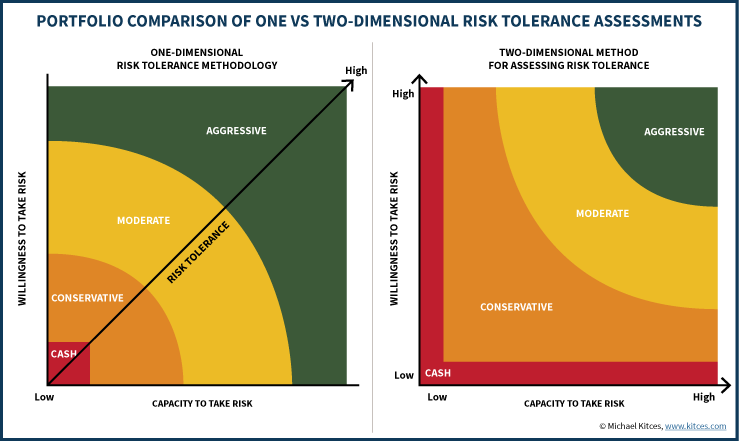
Most people think about market risk in terms of how it feels. Can you stomach watching your account drop 30% without panicking? That’s risk tolerance, and it matters, but it’s only half the picture.
Risk capacity is different. It’s not about how you feel watching a decline, it’s about whether your plan can actually absorb one without changing your life. A retiree with a pension covering most of their fixed expenses has real capacity to ride out a downturn, even if the sight of it makes them nervous. A retiree relying entirely on portfolio withdrawals for every dollar of spending has much less capacity, even if they consider themselves unbothered by volatility.
The mismatch between these two is where retirement plans get into trouble. Someone with high tolerance and low capacity can talk themselves into a portfolio that feels fine emotionally but can’t actually survive a bad sequence. Someone with low tolerance and high capacity might sit in cash unnecessarily, giving up growth they could have afforded to pursue. Getting this right means testing both questions separately instead of treating comfort as a proxy for what the plan can actually withstand.
Testing different scenarios
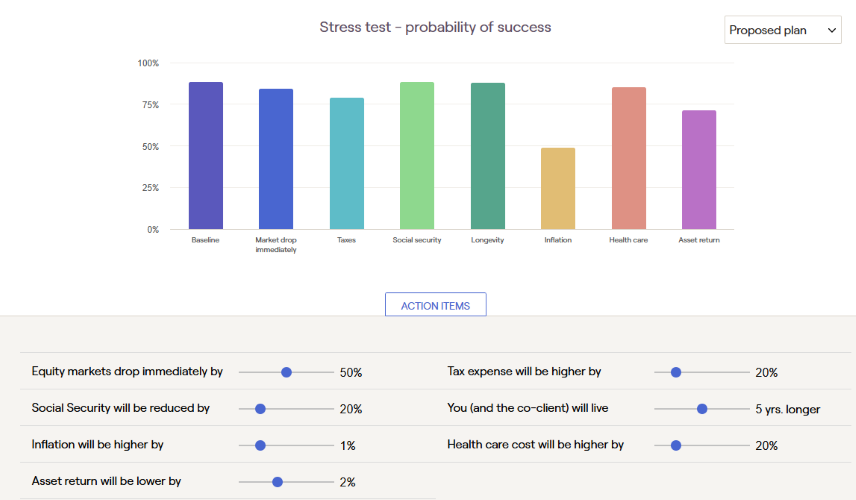
2008 is the scenario most people ask about, but it’s not the only shape a bad stretch can take, and a plan that survives one doesn’t automatically survive another.
A sudden 30-50% drawdown. This is the sharp, fast shock, closer to 2008 or 2020 than a slow grind. The test here is liquidity: does the plan have enough set aside in cash or short term holdings to cover near-term spending without being forced to sell equities at the bottom.
Rapid interest rate hikes. A fast rise in rates hits bond prices immediately, which matters more than people expect for a retiree holding a meaningful fixed income allocation. It’s worth checking what a repeat of 2022, when bonds and stocks fell in the same year, would do to a portfolio that’s counting on bonds to be the stable half.
A high, sustained inflation stretch. This one is slower and less dramatic than a crash, which is exactly why it’s easy to underweight in planning. A few years of high inflation quietly erodes purchasing power even if the portfolio balance looks fine on paper, and it changes the math on any withdrawal rate that isn’t adjusted for it. The 1970s are the historical case worth running, since it stressed portfolios for a decade rather than a single bad year.
Each of these stresses a different part of the plan. A crash tests liquidity and sequence risk. A rate spike tests the bond allocation specifically. Sustained inflation tests the withdrawal rate itself. Running all three, not just the one everyone remembers, is what actually tells you where a plan is fragile.
Cash buckets and guardrails: two ways to build in flexibility
Once you know where a plan is vulnerable, the next question is what to actually do about it. Two approaches come up often, and they solve the problem differently.
A cash bucket strategy sets aside one to three years of spending in cash or short-term instruments, separate from the invested portfolio. The purpose isn’t yield, it’s optionality. When the market is down, spending comes from the bucket instead of from selling depressed assets, which buys time for a recovery without locking in losses. The tradeoff is real too: money sitting in a cash bucket isn’t growing, so the strategy has a cost even in the years nothing goes wrong.
A guardrails strategy works differently. Instead of pre-funding a cash reserve, it sets predetermined thresholds, upper and lower portfolio values, that trigger a spending adjustment when crossed. If the portfolio falls below a lower guardrail, spending trims temporarily. If it rises above an upper one, there may be room to spend more. This approach treats retirement income as something that flexes with the portfolio rather than staying fixed, which tends to make a plan more resilient without requiring a large permanent cash allocation.
Neither approach is universally better. A cash bucket offers psychological comfort, a visible pool that isn’t tied to the market. Guardrails tend to be more capital-efficient over a full retirement, since less money sits on the sidelines, but they require being willing to adjust spending when a threshold is crossed rather than assuming the number is fixed. The right choice usually comes down to which tradeoff a specific retiree can actually live with, which is really the risk tolerance question again, applied to a specific mechanism instead of the portfolio as a whole.
How to stress-test the plan
Run the 2008 scenario specifically. Not a generic “what if the market drops 20%” question, but the actual sequence. Seeing the real numbers is what makes this exercise useful instead of theoretical.
Test more than one bad decade. The Great Financial Crisis was sharp and fast from a market perspective and so was the crash of the pandemic when markets dropped 35% in 20 trading sessions, faster than the Great Depression. Other downturns, the early 2000s or the 1970s, were slower and dragged out longer. The old adage, death by a thousand cuts comes to mind when remembering these former bear markets. A plan that survives a fast crash doesn’t automatically survive a slow bleed, and it’s worth checking both.
Look at what the withdrawal rate does to the numbers, not just the market. A crash is more survivable at a 3% withdrawal rate than a 5% one. Stress-testing isn’t just about the market, it’s about whether your spending plan gives the portfolio enough room to absorb a bad stretch without permanent damage.
Check what happens if the crash arrives in year one versus year ten. The same drop does very different amounts of damage depending on when it hits. A plan that looks fine on average can still be fragile in exactly the years that matter most.
What to do with the results
The point of this exercise isn’t to talk yourself out of retiring. It’s to know, in advance, what levers exist if a bad sequence actually happens. That might mean holding more cash or short-term bonds to cover a few years of spending without selling into a downturn. It might mean building flexibility into the plan so discretionary spending can flex down temporarily if needed. It might mean nothing changes at all, because the plan already has enough cushion built in.
What it shouldn’t mean is finding all of this out for the first time while the market is actually down 30% and your monthly withdrawal is due regardless.
The goal
Every retirement plan looks reasonable on a spreadsheet showing average returns. The plans that actually hold up are the ones that have already been tested against the specific, ugly scenario, not the smooth average one. Running those numbers before you need them turns a market crash from a crisis into something you already have an answer for.
Kitces, Michael. “Adopting A Two-Dimensional Risk Tolerance Assessment Process” Kitces.com
https://www.kitces.com/blog/tolerisk-aligning-risk-tolerance-and-risk-capacity-on-two-dimensions/?utm_campaign=ShareBar&utm_source=sharelink&utm_medium=Social
This article is for educational purposes only and does not constitute personalized investment, tax, or legal advice. Consult a qualified fiduciary advisor about your specific situation. Macallen Capital is a fee-only fiduciary RIA.