
A client told me he was ready to retire at 62. His portfolio could support it. His only hesitation was a single sentence: “I have no idea what I’ll do about health insurance.”
That hesitation is common, and it’s a reasonable one. Medicare doesn’t start until 65. If you retire earlier than that, and a lot of people do, there’s a gap to cover, sometimes three years, sometimes more. Health insurance during that gap tends to be the single most underestimated cost in an early retirement plan.
Why this catches people off guard
Most people have had employer-sponsored health insurance their entire working life. A chunk comes out of every paycheck, the employer covers a large share of the rest, and the whole system runs quietly in the background. Retiring early removes the employer subsidy all at once, and the real cost of coverage becomes visible for the first time in decades.
That cost can be a genuine shock. A couple in their early sixties buying coverage on the individual market can be looking at a real monthly number, often more than a mortgage payment, before subsidies are factored in.
The options, and how they actually compare
COBRA. This lets you keep your employer’s exact plan for up to 18 months, but you now pay the full premium yourself, including the portion your employer used to cover, plus an administrative fee. It’s familiar and requires no research, but it’s usually the most expensive option and only lasts a year and a half.
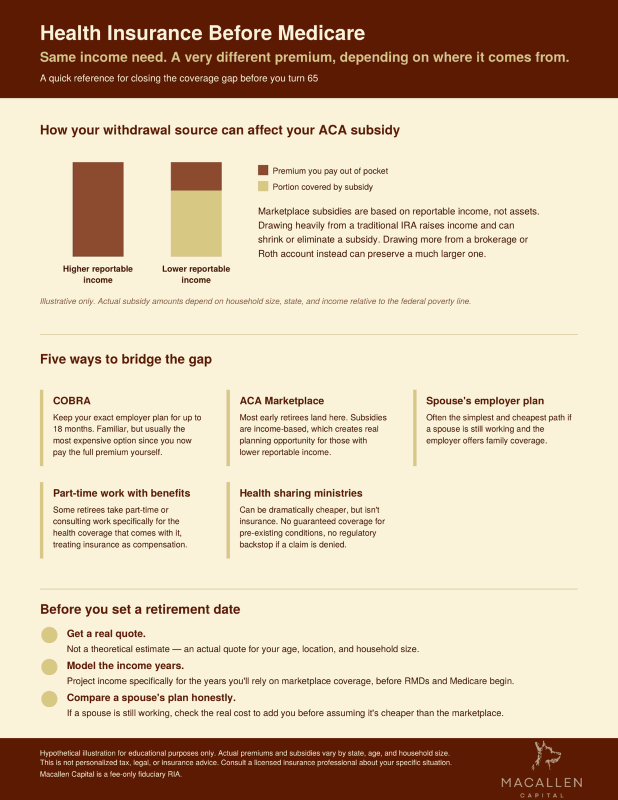
The ACA marketplace. This is where most early retirees land. Plans vary widely by state and county, but the bigger factor is often the subsidy, not the plan itself. Marketplace subsidies are based on income, not assets, which creates real planning opportunity. A retiree with a large portfolio but modest reportable income can qualify for meaningful subsidies, sometimes bringing the real cost of a marketplace plan below what people expect.
A spouse’s employer plan. If one spouse is still working, this is often the simplest and cheapest path, assuming the employer offers family coverage. Part-time work with benefits. Some retirees take on part-time or consulting work specifically because it comes with health coverage, treating the insurance as a form of compensation even if the paycheck itself is secondary.
Health sharing ministries. These aren’t insurance, and they don’t guarantee coverage the way a regulated plan does. They can be dramatically cheaper, but the tradeoff is real: no guaranteed coverage for pre-existing conditions and no regulatory backstop if a claim gets denied.
The part that actually requires planning
The ACA subsidy piece is where a financial plan and a health insurance decision start to overlap directly. Subsidies phase out as reportable income rises, which means the withdrawal strategy you use in early retirement doesn’t just affect your taxes. It can directly affect your health insurance premium. Pulling heavily from a traditional IRA in your early retirement years raises reportable income and can shrink or eliminate a subsidy. Drawing more from a brokerage account or a Roth, sources that don’t count the same way toward that income figure, can preserve a much larger subsidy. The account you choose to spend from in your early sixties isn’t just a tax decision anymore. It’s a health insurance decision too.
What to do before you retire early
Get a real quote before you commit to a date. The theoretical cost of coverage and the actual quoted premium for your age, location, and household size are often very different numbers, and it’s better to know that before you give notice, not after. Model your income for the specific years you’ll be relying on marketplace coverage. This is a case where the withdrawal order conversation and the health insurance conversation should happen together, not separately.
If a spouse is still working, find out what their plan actually costs to add a spouse, and compare that honestly against marketplace options rather than assuming it’s automatically cheaper. The gap is a planning problem, not a reason to wait None of this means early retirement isn’t worth pursuing. It means the health insurance gap deserves the same specific planning as the rest of the retirement decision, not a vague assumption that it’ll work itself out. The retirees who navigate this well are the ones who treat the three years before 65 as its own distinct planning period, not just an extension of the plan they’d already built for later.
This article is for educational purposes only and does not constitute personalized investment, tax, legal, or insurance advice. Consult a qualified fiduciary advisor and a licensed insurance professional about your specific situation. Macallen Capital is a fee-only fiduciary RIA.